
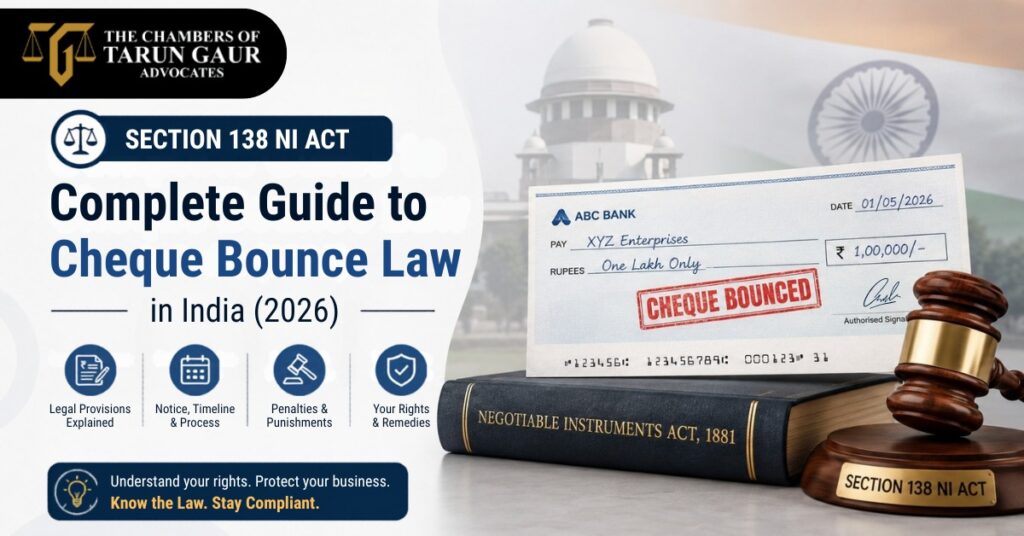
Cheque Bounce is one of the most common financial disputes in India. Every year, lakhs of cases are filed under Section 138 of the Negotiable Instruments Act, 1881. If you have received a legal notice or a court summons for cheque bounce, this detailed guide will help you understand your rights, liabilities, and the complete legal process.
What is Section 138 of the Negotiable Instruments Act?
Section 138 creates a criminal offence when a cheque is dishonoured (bounced) by the bank due to insufficient funds or other specified reasons. It is a quasi-criminal offence — it has both criminal punishment and civil recovery elements.
Legal Provision (Simplified):
Where any cheque drawn by a person on an account maintained by him with a banker for payment of any amount of money to another person is returned by the bank unpaid, either because of the amount of money standing to the credit of that account is insufficient to honour the cheque or that it exceeds the amount arranged to be paid from that account by an agreement made with that bank, such person shall be deemed to have committed an offence.
Essential Ingredients of Section 138 NI Act (Must be Proved)
For a case to succeed under Section 138, the complainant must prove the following five essential ingredients:
- Existence of a Legally Enforceable Debt (Presumption under Section 139)
- Presentation of Cheque within its validity period (usually 3 months)
- Dishonour of Cheque by the bank (due to insufficient funds, stop payment, account closed, etc.)
- Service of Legal Notice within 30 days of receiving bank memo
- Failure to Pay the cheque amount within 15 days of receiving the notice
If even one ingredient is missing, the case fails.
Punishment under Section 138 NI Act
- Imprisonment up to 2 years, or
- Fine up to twice the cheque amount, or
- Both
- Compensation to the complainant (usually the cheque amount + interest)
Complete Procedure in Cheque Bounce Cases
- Cheque Dishonour → Bank returns memo
- Legal Notice → Sent within 30 days
- 15 Days Payment Window → Accused must pay
- Filing Complaint → Within 30 days after 15-day period expires (under Section 142)
- Magistrate takes Cognizance
- Summons/Notice to Accused
- Evidence Stage (Affidavit evidence allowed)
- Judgment → Conviction or Acquittal
Important Time Limits (Most Common Mistakes):
- Notice: Within 30 days of dishonour memo
- Complaint: Within 30 days after expiry of 15 days from notice
- Total limitation is very strict — delay can be fatal.
Important Legal Presumptions
- Section 139: Court presumes that the cheque was issued for discharge of a debt or liability. Accused has to rebut this presumption.
- Section 118: Presumption as to date, consideration, etc.
- Besides above presumptions, there are two more important provisions under the law i.e. section 143A and section 148 of NI Act.
- Section 143-A of the Negotiable Instruments Act, 1881 empowers the trial court to award interim compensation to the complainant during the pendency of the trial. Under this provision, the complainant may file an application before the court seeking a direction to the accused to deposit a portion of the cheque amount (up to 20%) as interim compensation.
The Hon’ble Supreme Court, in Rakesh Ranjan Shrivastava v. State of Jharkhand (2024) 4 SCC 419 laid down the following guidelines to be followed to dispose of applications under section 143A.
27. Subject to what is held earlier, the main conclusions can be summarised as follows:
27.1. The exercise of power under sub-section (1) of Section 143-A is discretionary. The provision is directory and not mandatory. The word “may” used in the provision cannot be construed as “shall”.
27.2. While deciding the prayer made under Section 143-A, the court must record brief reasons indicating consideration of all relevant factors.
27.3. The broad parameters for exercising the discretion under Section 143-A are as follows:
27.3.1. The court will have to prima facie evaluate the merits of the case made out by the complainant and the merits of the defence pleaded by the accused in the reply to the application. The financial distress of the accused can also be a consideration.
27.3.2. A direction to pay interim compensation can be issued, only if the complainant makes out a prima facie case.
27.3.3. If the defence of the accused is found to be prima facie plausible, the court may exercise discretion in refusing to grant interim compensation.
27.3.4. If the court concludes that a case is made out to grant interim compensation, it will also have to apply its mind to the quantum of interim compensation to be granted. While doing so, the court will have to consider several factors such as the nature of the transaction, the relationship, if any, between the accused and the complainant, etc.
27.3.5. There could be several other relevant factors in the peculiar facts of a given case, which cannot be exhaustively stated. The parameters stated above are not exhaustive.”
In Kapur Singh v. State of Haryana (2021) 18 SCC 579, the Hon’ble Supreme Court held that non deposit of interim compensation under section 143A NI Act, does not mean jail!
The Court held as follows:
6. In my considered view, the question of the petitioner surrendering before the trial court, as a precondition for entertaining the above SLP, does not arise. Order XXII Rule 5 of the Supreme Court Rules, 2013, makes it mandatory for a person to surrender or seek exemption from surrendering only when he has been sentenced to a term of imprisonment. The petitioner has not been sentenced to any term of imprisonment, by the orders impugned in the SLP. The orders out of which the above SLP arises, are orders passed for failure to comply with the directions issued under Section 143-A of the NI Act.
7.The consequences of failure to comply with the directions issued under Section 143-A are spelt out in sub-section (5) of Section 143-A. Sub-section (5) merely provides for the recovery of the interim compensation ordered under Section 143-A, as if it were a fine, under Section 421 of the Code of Criminal Procedure, 1973. Section 421(1)CrPC prescribes two methods for recovery of fine. They are (i) recovery by attachment and sale of any movable property; and (ii) recovery through the Collector of the district as if the amount represents arrears of land revenue.
8. The proviso to sub-section (1) of Section 421CrPC deals separately with cases where imprisonment for a particular term is awarded in default of payment of fine. That situation has not arisen here.
9. When Section 143-A(5) of the NI Act read with Section 421(1)CrPC does not prescribe a term of imprisonment and when the orders impugned in the SLP do not challenge any penalty of imprisonment for a particular term, the question of the petitioner surrendering or seeking exemption from surrendering does not arise. In other words, in cases of this nature, the Registry cannot insist upon either a surrender certificate or an application for exemption from surrendering under Order XXII Rule 5 of the Rules.”
b. Section 143-A of the NI Act operates at the pre-conviction stage (during the trial), whereas Section 148 comes into play at the post-conviction stage, when the accused, after being convicted under Section 138, prefers an appeal against the conviction and sentence.
In this context, the Hon’ble Supreme Court, in its earlier decision in Surinder Singh Deswal v. Virender Gandhi (2019) 11 SCC 341, carried out a purposive interpretation of Section 148 and held that the deposit of a minimum 20% of the compensation/fine amount as a precondition for suspension of sentence and hearing of the appeal is generally mandatory (the word “may” being construed as “shall”/a rule).
However, a later coordinate Bench of the Supreme Court in Jamboo Bhandari v. Madhya Pradesh State Industrial Development Corporation Ltd. (2023) 10 SCC 446 (followed and reinforced in Muskan Enterprises v. State of Punjab, (2024) 20 SCC 85) held differently. It clarified that the requirement of deposit under Section 148 is not absolute or mandatory in every case. The appellate court has the discretion to suspend the sentence without directing any deposit (or with a reduced amount) in exceptional cases, provided it records specific reasons showing that imposing such a condition would be unjust or would amount to deprivation of the right of appeal.
Strong Defences Available to Accused
- No legally enforceable debt (loan already repaid, gift, security cheque)
- Cheque was stolen / lost / forged
- Stop payment due to bona fide reasons (not to cheat)
- Limitation expired
- Notice not properly served
- Signature mismatch / Different account
- Company cheque – Director not in charge
Practical Tips
For Complainant (Payee):
- Always keep proof of debt/transaction
- Send notice through Speed Post + Email + WhatsApp
- File case promptly
- Consider filing both criminal (138) + civil recovery suit
For Accused (Drawer):
- Reply to notice immediately with strong reasons
- Gather proof that there was no debt or cheque was misused
- Consult a good lawyer before filing reply
Can cases under Section 138 NI Act be Settled?
Yes. Offence under Section 138 is compoundable. Cases can be settled at any stage (even during appeal) with mutual consent of the parties, however the Hon’ble Supreme Court, in Damodar S. Prabhu v. Sayed Babalal H., (2010) 5 SCC 663, has laid down certain guidelines narrating as to how and with what penalty, the cases can be settled at different stages of the proceedings.
The court held as follows:
“21. With regard to the progression of litigation in cheque bouncing cases, the learned Attorney General has urged this Court to frame guidelines for a graded scheme of imposing costs on parties who unduly delay compounding of the offence. It was submitted that the requirement of deposit of the costs will act as a deterrent for delayed composition, since at present, free and easy compounding of offences at any stage, however belated, gives an incentive to the drawer of the cheque to delay settling the cases for years. An application for compounding made after several years not only results in the system being burdened but the complainant is also deprived of effective justice. In view of this submission, we direct that the following guidelines be followed:
THE GUIDELINES
(i) In the circumstances, it is proposed as follows:
(a) That directions can be given that the writ of summons be suitably modified making it clear to the accused that he could make an application for compounding of the offences at the first or second hearing of the case and that if such an application is made, compounding may be allowed by the court without imposing any costs on the accused.
(b) If the accused does not make an application for compounding as aforesaid, then if an application for compounding is made before the Magistrate at a subsequent stage, compounding can be allowed subject to the condition that the accused will be required to pay 10% of the cheque amount to be deposited as a condition for compounding with the Legal Services Authority, or such authority as the court deems fit.
(c) Similarly, if the application for compounding is made before the Sessions Court or a High Court in revision or appeal, such compounding may be allowed on the condition that the accused pays 15% of the cheque amount by way of costs.
(d) Finally, if the application for compounding is made before the Supreme Court, the figure would increase to 20% of the cheque amount.”
Furthermore, a situation often arises where the complainant has received the entire due amount, yet he refuses to give consent for compounding the offence and discharge of the accused.
The Hon’ble Supreme Court has consistently held that criminal proceedings under Section 138 of the Negotiable Instruments Act can be quashed even without the complainant’s consent, provided it is demonstrated that the complainant has been adequately compensated and that the continuation of the criminal proceedings would cause grave injustice to the accused.
The Court, in Raj Reddy Kallem v. State of Haryana, (2024) 8 SCC 588, held as follows:
“20. This Court in Meters & Instruments (P) Ltd. v. Kanchan Mehta [Meters & Instruments (P) Ltd. v. Kanchan Mehta, (2018) 1 SCC 560 : (2018) 1 SCC (Civ) 405 : (2018) 1 SCC (Cri) 477] after discussing the series of judgments including JIK Industries [JIK Industries Ltd. v. Amarlal V. Jumani, (2012) 3 SCC 255 : (2012) 2 SCC (Civ) 82 : (2012) 2 SCC (Cri) 125] observed that even in the absence of “consent” court can close criminal proceedings against an accused in cases of Section 138 of the NI Act if the accused has compensated the complainant. The exact words of this Court were as follows : (Kanchan Mehta case [Meters & Instruments (P) Ltd. v. Kanchan Mehta, (2018) 1 SCC 560 : (2018) 1 SCC (Civ) 405 : (2018) 1 SCC (Cri) 477] , SCC p. 572, para 18.3)
“18.3. Though compounding requires consent of both parties, even in absence of such consent, the court, in the interests of justice, on being satisfied that the complainant has been duly compensated, can in its discretion close the proceedings and discharge the accused.”
In our opinion, Kanchan Mehta [Meters & Instruments (P) Ltd. v. Kanchan Mehta, (2018) 1 SCC 560 : (2018) 1 SCC (Civ) 405 : (2018) 1 SCC (Cri) 477] nowhere contemplates that “compounding” can be done without the “consent” of the parties and even the above observation of Kanchan Mehta [Meters & Instruments (P) Ltd. v. Kanchan Mehta, (2018) 1 SCC 560 : (2018) 1 SCC (Civ) 405 : (2018) 1 SCC (Cri) 477] giving discretion to the trial court to “close the proceedings and discharge the accused”, by reading Section 258 [ “258. Power to stop proceedings in certain cases.—In any summons-case instituted otherwise than upon complaint, a Magistrate of the first class or, with the previous sanction of the Chief Judicial Magistrate, any other Judicial Magistrate, may, for reasons to be recorded by him, stop the proceedings at any stage without pronouncing any judgment and where such stoppage of proceedings is made after the evidence of the principal witnesses has been recorded, pronounce a judgment of acquittal, and in any other case, release the accused, and such release shall have the effect of discharge.”] CrPC, has been held to be “not a good law” by this Court in the subsequent five-Judge Bench judgment in Expeditious Trial of Cases Under Section 138 of NI Act, 1881, In re [Expeditious Trial of Cases Under Section 138 of NI Act, 1881, In re, (2021) 16 SCC 116, para 20]. …
- Even though the complainant is unwilling to compound the case but, considering the totality of facts and circumstances of the present case which we have referred above, we are of the considered view that these proceedings must come to an end. We, therefore, allow this appeal and set aside the impugned order of the High Court dated 29-11-2022 [Raj Reddy Kallem v. State of Haryana, 2022 SCC OnLine P&H 4284] . We also quash all the criminal proceedings qua the appellant arising out of FIR No. 35 of 2014 at PS Mahesh Nagar, Ambala pending before the Chief Judicial Magistrate, Ambala.
- Since, criminal appeals filed by the present appellant against his conviction under Section 138 of the NI Act are also pending, we deem it appropriate that the said proceedings should also be quashed. Hence, in order to do complete justice, we exercise our powers under Article 142 of the Constitution of India, and hereby quash all the pending criminal appeals on the file of the Additional Sessions Judge, Ambala Cantt., against the appellant in the present matter, and set aside the conviction and sentence awarded to the appellant by the trial court.”
Conclusion
Section 138 of the Negotiable Instruments Act is a powerful tool to recover money and punish dishonest cheque issuers. However, both complainants and accused need to follow the strict procedural requirements. One small mistake in timelines or notice can result in the entire case being dismissed.
If you have received a cheque bounce notice or a court summons, do not ignore it. Consult an experienced lawyer immediately.
FAQs on Section 138 NI Act
Q1. Can I file a case if cheque is 4 months old?
No. Cheque must be presented within 3 months (validity period).
Q2. Is stop payment a valid defence?
Only if there is a genuine reason. Blanket stop payment to avoid payment is not allowed.
Q3. Can directors be held liable in company cheque bounce?
Yes, if they were in charge and responsible (Section 141).
Q4. Can I get interim compensation?
Yes, but it is discretionary as per Supreme Court’s judgment in Rakesh Ranjan Shrivastava v. State of Jharkhand.