
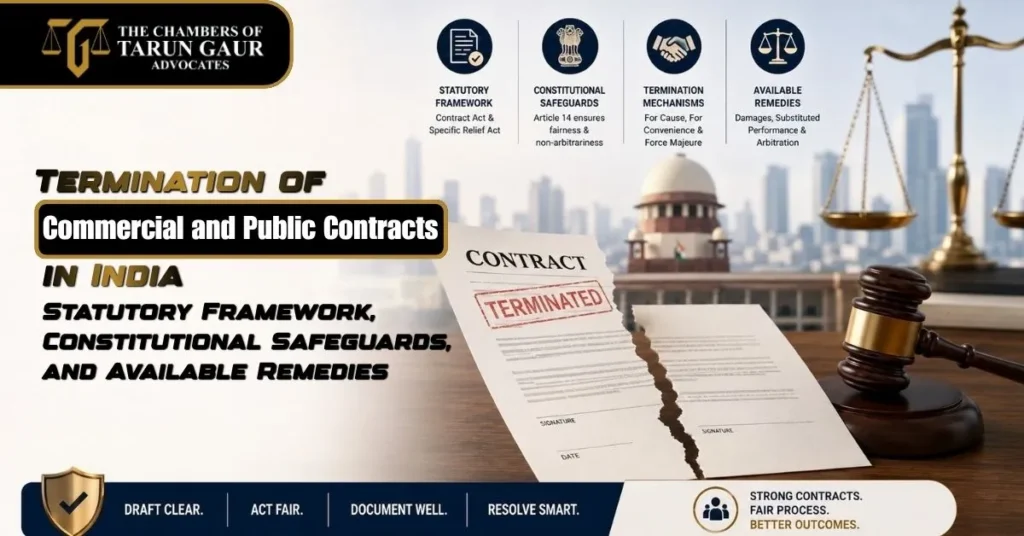
Introduction
Termination of commercial contracts in India is a critical area that balances contractual freedom with statutory limitations and constitutional principles. While private contracts are largely governed by their express terms and the Indian Contract Act, 1872, public procurement and government contracts attract additional scrutiny under Article 14 of the Constitution, demanding fairness, non-arbitrariness, and adherence to natural justice.
For every Commercial dispute lawyer in Delhi and Arbitration lawyer in Delhi, understanding the legal framework governing contract termination is essential for advising businesses, contractors, government entities, and investors involved in high-value commercial relationships.
The Specific Relief Act, 1963 (as amended in 2018) provides the primary remedial architecture, shifting the focus from traditional specific performance to substituted performance and damages in most termination scenarios. Recent Supreme Court and High Court rulings have clarified the limits of judicial intervention, the distinction between termination and blacklisting, and the enforceability of termination-for-convenience clauses. This evolving jurisprudence promotes commercial certainty while protecting public interest in government contracts.
Core Statutory Framework
Specific Relief Act, 1963 (as amended)
- Section 10: Specific performance of a contract is enforceable subject to the bars contained in Sections 11(2), 14, and 16. It remains an equitable, discretionary remedy.
- Section 14: Contracts that are determinable (i.e., terminable at will or by notice) are not specifically enforceable. This provision is pivotal in termination disputes, as most commercial contracts contain termination clauses, thereby directing parties towards damages rather than reinstatement of the contract.
- Section 20 (post-2018 amendment): Introduces substituted performance. The aggrieved party may, after giving notice to the breaching party, arrange for performance through a third party or its own agency and recover the costs and expenses from the defaulting party. This is a pragmatic, self-help remedy that avoids prolonged litigation.
- Sections 20A–20C (inserted by 2018 Amendment): Provide for special courts, expeditious disposal of suits relating to infrastructure projects, and stricter timelines, reflecting legislative intent to minimise delays in critical sectors.
Constitutional Overlay (Article 14)
In government and public procurement contracts, every termination decision must satisfy the test of reasonableness and non-arbitrariness. Unilateral or capricious terminations are vulnerable to judicial review, though courts exercise restraint and do not sit in appeal over commercial or technical judgments.
Public Procurement Rules (e.g., Madhya Pradesh Municipalities (Accounts and Finance) Rules, 2018)
These rules prescribe standard conditions on force majeure, liquidated damages, price variation, and termination, providing structured risk allocation in municipal and state-level contracts.
Landmark Judicial Pronouncements
Central Organisation for Railway Electrification (CORE) v. ECI SPIC SMO MCML (JV) (2025) 4 SCC 641
A Constitution Bench held that government contracts are subject to Article 14 discipline. Unilateral arbitrator appointment clauses are impermissible, and procedures relating to termination and dispute resolution must ensure fairness and impartiality.
Municipal Corpn., Ujjain v. BVG India Ltd. (2018) 5 SCC 462
The Supreme Court emphasised limited judicial review in procurement and termination matters. Courts interfere only where there is manifest arbitrariness, mala fides, or violation of public interest. Technical and commercial decisions of the employer deserve deference.
N.G. Projects Ltd. v. Vinod Kumar Jain (2022) 6 SCC 127
Reiterated that interpretation of tender conditions and termination decisions rest primarily with the procuring entity. Judicial intervention is exceptional.
High Court Rulings on Termination and Blacklisting
- Anil Kumar Maggu v. Food Corpn. of India (Delhi HC, 2024): Termination-for-convenience clauses are enforceable if contractually agreed and not unconscionable. The remedy for wrongful invocation is damages, not specific performance.
- Oasis Projects Ltd. v. NHIDCL (Delhi HC, 2024), Gayatri Webtech (P) Ltd. v. DDA (Delhi HC, 2024), and KTR Constructions v. State of Karnataka (Karnataka HC, 2024): Blacklisting or debarment is a distinct and grave penalty. It does not automatically follow termination and requires a separate show-cause notice, reasoned order, and adherence to principles of natural justice and proportionality.
- A.K.G. Construction & Developers (P) Ltd. v. State of Jharkhand (Supreme Court, 2026): Reinforced that termination and blacklisting are separate actions demanding independent procedural safeguards.
These rulings are frequently relied upon by every Commercial dispute lawyer in Delhi handling procurement disputes, contract termination challenges, and claims arising from wrongful termination.
Key Judicial Principles
1. Determinable Contracts
Specific performance is barred under Section 14 where the contract is terminable. Aggrieved parties must ordinarily seek damages.
2. Substituted Performance
A powerful, practical remedy under Section 20. Proper notice is mandatory, after which costs can be recovered from the breaching party.
3. Article 14 in Public Contracts
Termination must be fair and reasoned. Courts will strike down arbitrary or mala fide decisions but will not re-appreciate commercial wisdom.
4. Termination for Convenience
Enforceable if clearly stipulated, but arbitrary exercise attracts damages liability.
5. Blacklisting as Separate Penalty
Requires independent proceedings with full natural justice compliance. Mere termination does not justify automatic debarment.
6. Limited Judicial Review
Writ courts exercise restraint in contractual matters involving public authorities, intervening only in cases of illegality or unfairness.
7. Expeditious Resolution
Infrastructure-related termination disputes benefit from faster timelines under the 2018 Amendment.
Practical and Actionable Guidance
For Employers / Public Authorities:
- Draft clear termination clauses (for cause and for convenience) with defined notice and cure periods.
- Ensure termination decisions are reasoned, documented, and compliant with Article 14.
- Segregate termination from blacklisting: issue a separate, specific show-cause notice before any debarment.
- Use substituted performance under Section 20 where appropriate and maintain meticulous cost records.
For Contractors:
- Upon receiving termination notice, promptly assess legality and gather evidence of arbitrariness.
- Prefer damages claims or arbitration over specific performance where Section 14 bars apply.
- Challenge procedurally flawed blacklisting orders through writ petitions, emphasising violation of natural justice.
- Comply with notice requirements before invoking substituted performance.
Drafting Recommendations:
- Include robust force majeure, liquidated damages, and dispute resolution clauses aligned with CORE judgment (independent arbitration).
- In public contracts, ensure clauses are balanced and non-unconscionable to withstand Article 14 scrutiny.
For every Arbitration lawyer in Delhi, careful drafting of dispute resolution mechanisms and arbitration clauses remains critical because many termination disputes ultimately proceed to arbitration and post-award enforcement proceedings.
Conclusion
Indian law on contract termination reflects a mature balance between party autonomy, commercial pragmatism, and constitutional fairness. The Specific Relief (Amendment) Act, 2018, coupled with authoritative rulings from the Supreme Court and High Courts, has tilted the regime towards substituted performance, damages, and expeditious resolution rather than prolonged battles for specific performance.
For every Commercial dispute lawyer in Delhi, these developments reinforce the importance of careful contract drafting, procedural compliance, and strategic dispute resolution planning. Likewise, every Arbitration lawyer in Delhi must remain attentive to evolving jurisprudence governing termination disputes, arbitration clauses, and enforcement mechanisms.
For businesses and government entities alike, meticulous contract drafting, procedural compliance, and clear documentation remain the best safeguards against disputes. When termination becomes inevitable, adherence to statutory remedies and constitutional standards ensures outcomes that are both legally robust and commercially sensible. This framework continues to strengthen India’s reputation as a predictable and fair jurisdiction for commercial contracting.