
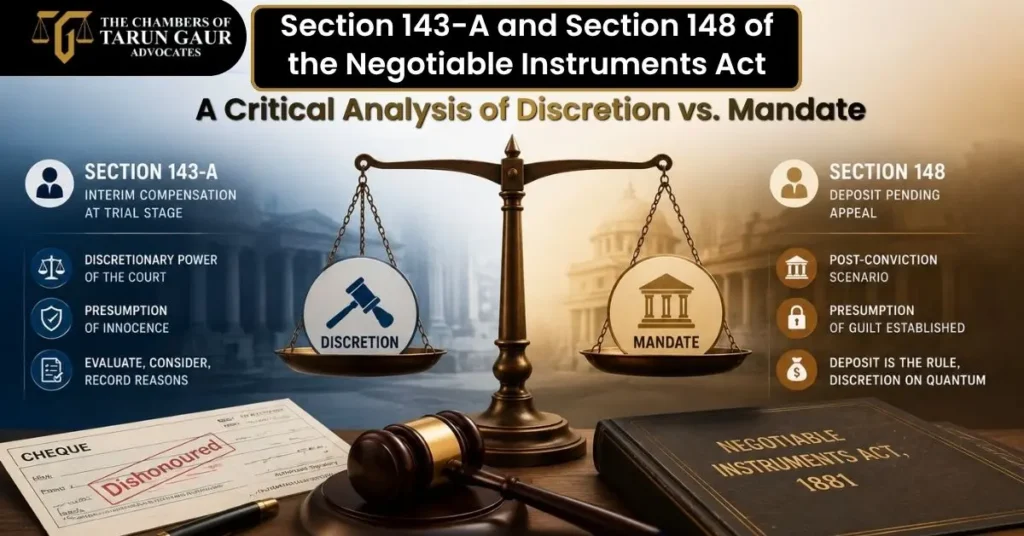
The Negotiable Instruments Act, 1881, particularly Section 138, was enacted to instill faith in the banking system and curb the growing menace of cheque dishonour. Parliament has strengthened this law over time through amendments, notably introducing Section 143-A (interim compensation at trial stage) and Section 148 (deposit pending appeal) via the 2018 Amendment. The recurring use of the word “may” in both provisions has led to significant judicial interpretation. While the Supreme Court has rightly treated “may” in Section 143-A as discretionary, the same liberal approach in Section 148 risks diluting the deterrent effect of the Act.
Section 143-A NI Act: Correctly Read as Directory/Discretionary
Section 143-A empowers the trial court to direct the accused to pay interim compensation (up to 20% of the cheque amount) even before recording a finding of guilt. In Rakesh Ranjan Shrivastava v. State of Jharkhand (2024) 4 SCC 419, the Supreme Court (Justice Abhay S. Oka) emphatically held that the word “may” is directory and not mandatory.
This interpretation is constitutionally sound and aligned with criminal jurisprudence. At the pre-conviction stage, the accused enjoys the presumption of innocence. Imposing a mandatory financial burden before proof of guilt would amount to penalising a person who is yet to be held liable. It would also expose Section 143-A to challenge under Article 14 for manifest arbitrariness. The Court rightly laid down guidelines: the trial court must evaluate prima facie merits of the complaint, consider the defence, financial condition of the accused, nature of transaction, and record brief reasons. Mechanical orders directing deposit without application of mind are unsustainable.
My Take: The Supreme Court deserves full appreciation for protecting the foundational principles of criminal law. Forcing every person facing a cheque dishonour trial to deposit money as a threshold penalty would convert a quasi-criminal proceeding into a money recovery mechanism, defeating the object of a fair trial.
Section 148 NI Act: The Post-Conviction Scenario Demands a Stronger Mandate
Section 148 operates after conviction. The provision states that in an appeal against conviction under Section 138, the appellate court “may order the appellant to deposit such sum which shall be a minimum of twenty per cent” of the fine or compensation awarded by the trial court.
In Surinder Singh Deswal (2019), the Court leaned towards treating it as a rule. However, Jamboo Bhandari v. M.P. SIDC Ltd. (2023) 10 SCC 446 and Muskan Enterprises v. State of Punjab (2024) 20 SCC 85 have held that “may” confers real discretion — the appellate court can, in exceptional cases, suspend sentence without directing any deposit after recording reasons.
My Strong Disagreement with this Approach:
Once a person has been convicted after a full trial, the presumption of innocence stands rebutted. The legislative intent behind the 2018 amendment was crystal clear — to prevent unscrupulous drawers from abusing the appellate process and delaying payment to the honest payee. The object of the NI Act is not merely adjudication but deterrence. Allowing convicted persons to seek suspension of sentence and bail without any deposit is akin to permitting a convict to remain out of custody even when the trial court has specifically directed imprisonment. It undermines the sanctity of the conviction.
Parliament consciously used both “may” and “shall” in the same sentence. The correct way to read it is:
- The word “may” gives the appellate court discretion to decide whether a deposit is required in a given case (though this discretion should be exercised sparingly post-conviction).
- The phrase “which shall be a minimum of twenty per cent” makes it mandatory that if the court decides to order a deposit, the amount cannot be less than 20%.
However, in my firm view, the overall provision should be read as near-mandatory in character. The appellate court should have discretion primarily on the quantum — it may direct 20%, 30%, 50%, or even higher depending on the facts — but the default position after conviction must be that some deposit is required as a precondition for suspension of sentence and hearing of the appeal. Treating it as purely discretionary defeats the deterrent purpose of the Act.
Why the Distinction Between 143-A and 148 Matters
| Stage | Provision | Presumption | Nature of Power | Recommended Reading |
| Trial (Pre-conviction) | 143-A | Innocence | Directory/Discretionary | Correctly held by SC |
| Appeal (Post-conviction) | 148 | Guilt established | Near-Mandatory | Discretion only on quantum |
The legislature could have used “shall” throughout Section 148 if it wanted zero discretion. But the basic nature of the NI Act — to curb the rampant issuance of cheques without intent to honour them — demands that a convicted person cannot enjoy the fruits of appeal without showing some seriousness towards discharging the liability.
Allowing blanket discretion at the appellate stage sends a wrong message: “Get convicted, file an appeal, and stay out without paying a single rupee.” This is antithetical to the object of creating a strong deterrent against financial misconduct.
Conclusion: Time to Revisit the Balance
The Supreme Court has done well in Rakesh Ranjan Shrivastava by protecting the accused at the pre-conviction stage. However, the expansive reading of discretion in Jamboo Bhandari and Muskan Enterprises for Section 148 needs reconsideration by a larger Bench. Parliament’s intent was to strengthen cheque credibility. Post-conviction, the scales must tilt in favour of the complainant.
The appellate courts should exercise discretion on the amount to be deposited, but the principle that a convicted drawer must deposit a reasonable sum as a condition precedent to suspension of sentence and entertainment of appeal must be firmly upheld. Only then will the law truly serve its purpose — to make people think twice before issuing cheques with no intention of honouring them.
The fight against the “cheque bounce epidemic” cannot be won by giving convicted persons easy escape routes at the appellate stage. Deterrence demands deposit. Discretion on quantum is acceptable; complete waiver post-conviction is not.