
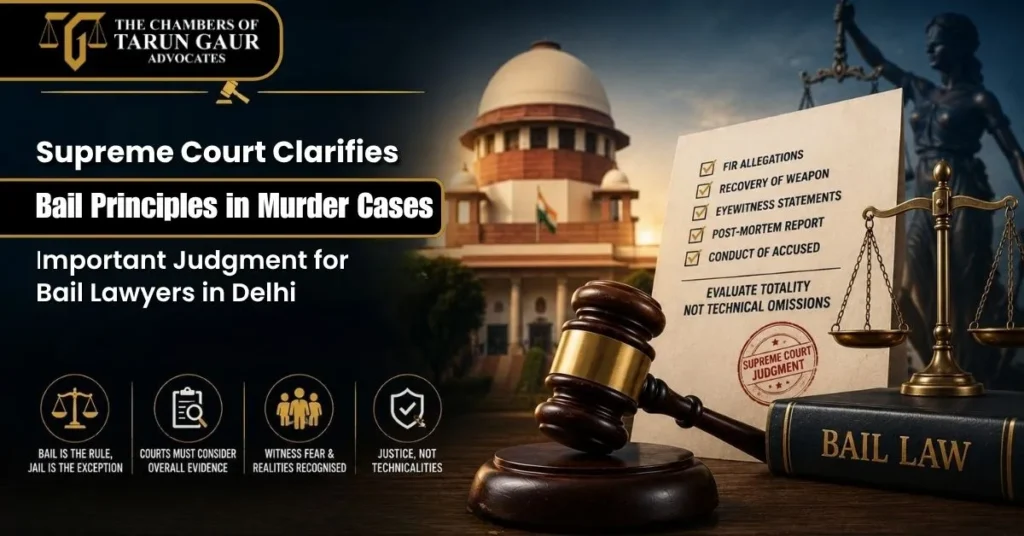
On 22 May 2026, the Supreme Court delivered a significant and much-needed judgment in Bhagat Singh v. State of Uttar Pradesh (Criminal Appeal arising out of SLP (Crl.) No. 4240 of 2026). The Court set aside the bail granted by the Allahabad High Court to the main accused in a brutal daylight murder case, holding that the mere non-mention of the accused’s name in the inquest proceedings cannot, by itself, be a valid ground for grant of bail in serious criminal offences.
This judgment is highly important for every criminal lawyer in Delhi and every advocate handling serious bail matters before the Sessions Court and Delhi High Court. The Supreme Court has reaffirmed that courts must evaluate the overall evidence collected during investigation instead of relying on isolated procedural omissions.
The Facts in Brief
The appellant, Bhagat Singh, is the nephew of the deceased Bharat Singh alias Pappu. On 8 March 2025, while the deceased and the appellant were proceeding towards their agricultural field in Mathura district, the accused Kunwarpal Singh along with two others allegedly emerged from hiding, surrounded the deceased, abused him, and fired multiple shots from country-made pistols, causing his death on the spot.
An FIR was promptly registered and the accused was specifically named with a direct overt act of firing. During investigation, a .315 bore country-made pistol and spent cartridge were recovered at the instance of the accused. The post-mortem report also supported the prosecution version.
Despite these circumstances, the Allahabad High Court granted bail primarily because the accused’s name was allegedly not mentioned during the inquest proceedings.
The High Court’s Flawed Approach
The Supreme Court strongly criticised the High Court’s reasoning and observed that the order granting bail was cryptic and legally unsustainable. The Court clarified that inquest proceedings under Section 194 of the Bharatiya Nagarik Suraksha Sanhita, 2023 are conducted only to determine the apparent cause of death and not to record detailed evidence or identify all accused persons.
This principle is extremely important in serious criminal litigation where accused persons frequently rely upon technical discrepancies or procedural lapses to seek bail despite substantial incriminating material.
Supreme Court Reaffirms Settled Bail Principles
Relying upon earlier judgments including Pedda Narayana v. State of A.P. and Amar Singh v. Balwinder Singh, the Supreme Court reiterated that:
- The purpose of inquest proceedings is limited.
- Non-mention of the accused in the inquest report cannot override direct allegations in the FIR.
- Courts must consider the entire evidence including recovery, witness statements, post-mortem findings, and conduct of the accused.
For any experienced bail lawyer in Delhi, this judgment serves as an important precedent demonstrating that courts must adopt a holistic approach while deciding bail applications in serious criminal matters.
Practical Reality Recognised by the Court
One of the most important aspects of this judgment is that it indirectly acknowledges the practical realities of criminal investigation in rural India. The Supreme Court recognised that inquest proceedings are often conducted hurriedly, and witnesses may hesitate to name influential accused persons at the earliest stage due to fear, pressure, or local influence.
The Court also acknowledged that the FIR registered after proper investigation carries far greater evidentiary significance than omissions in the inquest report.
Why This Judgment Matters
1. It Prevents Misuse of Technicalities
The judgment discourages the growing tendency of accused persons to rely solely upon procedural omissions while ignoring the substantive evidence collected during investigation.
2. It Strengthens Serious Criminal Prosecution
The Court reaffirmed that bail in heinous offences must be decided by considering the totality of circumstances rather than isolated documents.
3. It Supports Witness Protection
The judgment recognises that witnesses in rural areas may initially hesitate to identify powerful accused persons due to fear or intimidation.
4. It Guides Lower Courts
The Supreme Court clearly indicated that casual or non-speaking bail orders in serious criminal cases will not be tolerated.
Importance for Bail Litigation in Delhi High Court
This judgment is particularly important for advocates appearing before the Delhi High Court and Sessions Courts in serious criminal matters. Every experienced advocate handling bail litigation understands that successful criminal defence requires careful analysis of the complete prosecution record rather than selective reliance on technical irregularities.
The ruling also reinforces the importance of engaging the best lawyer for bail in Delhi high court when facing serious criminal allegations, as bail jurisprudence in such matters requires deep understanding of procedural law, evidentiary standards, and constitutional principles governing personal liberty.
Conclusion
The judgment in Bhagat Singh v. State of Uttar Pradesh is a welcome and balanced decision that restores clarity in criminal bail jurisprudence. The Supreme Court rightly held that non-mention of an accused in an inquest report cannot, by itself, become a ground for granting bail when other material strongly implicates the accused.
For every criminal lawyer in Delhi, this judgment serves as an important reminder that courts must focus on the overall strength of the prosecution case rather than isolated procedural omissions.