
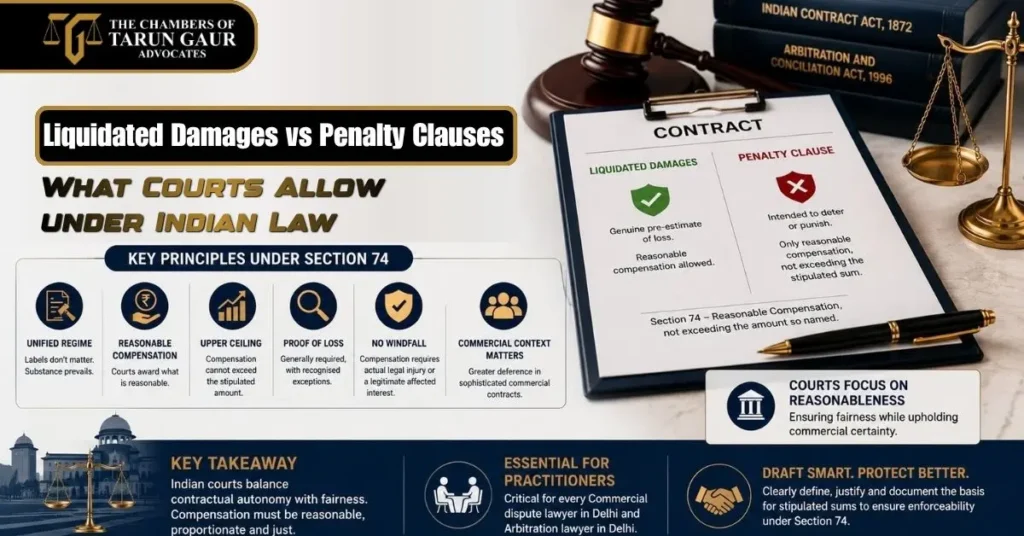
Liquidated damages (LD) and penalty clauses are ubiquitous in commercial contracts. Construction agreements, supply contracts, shareholder arrangements, financing transactions, and service agreements routinely stipulate a sum payable upon breach. Yet parties often misunderstand the legal effect of such clauses. Indian law, unlike traditional English common law, does not rigidly invalidate “penalty” clauses while fully enforcing “liquidated damages” clauses. Instead, Section 74 of the Indian Contract Act, 1872 creates a unified regime centred on “reasonable compensation.”
For every Commercial dispute lawyer in Delhi and Arbitration lawyer in Delhi, understanding the distinction between liquidated damages and penalty clauses is essential when drafting contracts, pursuing damages claims, or defending breach of contract allegations.
Statutory Foundation: Section 74
Section 74 provides that when a contract specifies a sum to be paid upon breach, or contains any other stipulation by way of penalty, the aggrieved party is entitled to receive reasonable compensation not exceeding the amount so named.
The key consequences are:
- The court awards reasonable compensation, not the full stipulated sum as a matter of right.
● Proof of actual loss is not mandatory in all cases (the phrase “whether or not actual damage or loss is proved” dispenses with strict proof in appropriate circumstances).
● The stipulated amount serves as an upper ceiling; courts cannot award more.
● The focus is on reasonableness, assessed primarily at the time of contracting in light of anticipated consequences.
This provision was enacted to eliminate the “elaborate refinements” and technical distinctions of English law. Indian courts therefore look to the substance of the clause rather than its label. A clause whose predominant purpose is to deter breach (in terrorem) is treated more strictly, while one representing a genuine commercial allocation of risk receives greater deference.
Contrast with English Common Law
Under English law (classically Dunlop Pneumatic Tyre Co Ltd v New Garage and Motor Co Ltd [1915] AC 79, refined in Cavendish Square Holding BV v Makdessi [2015] UKSC 67), LD clauses are enforceable if they constitute a genuine pre-estimate of loss or protect a legitimate interest of the innocent party. Pure penalty clauses (extravagant sums intended to punish or deter) are unenforceable; the innocent party recovers only actual damages.
Indian law consciously rejected this binary. Section 74 provides a single, simpler rule applicable to all stipulations. Courts do not refuse enforcement outright on the ground that a clause is a “penalty”; instead, they award reasonable compensation up to the cap. This promotes commercial certainty while retaining judicial oversight against oppression or unconscionability.
Judicial Evolution: From Fateh Chand to Morgan Securities
The Supreme Court has shaped the application of Section 74 through landmark rulings. This evolving jurisprudence is particularly important for every Commercial dispute lawyer in Delhi advising businesses on contractual risk allocation and enforcement strategy.
Fateh Chand v. Balkishan Das (1963)
A foundational decision. The Court held that Section 74 applies to all stipulations—whether described as penalty or LD—and to forfeiture clauses. Courts must award only reasonable compensation; they cannot enforce a penalty as such.
Maula Bux v. Union of India (1970)
The Court reaffirmed that forfeiture of earnest money or security deposits is subject to Section 74. Reasonable compensation principles apply.
ONGC Ltd. v. Saw Pipes Ltd. (2003)
In a commercial supply contract, the Court upheld deduction of LD for delay. It recognised that in complex commercial contracts where actual loss is difficult to quantify, a genuine pre-estimate agreed by sophisticated parties can be enforced without strict proof of loss.
Kailash Nath Associates v. Delhi Development Authority (2015)
Justice R.F. Nariman clarified several key principles:
- Genuine pre-estimates may be recoverable as reasonable compensation.
● Penalty clauses attract only reasonable compensation.
● The stipulated amount is always the ceiling.
● Proof of loss is generally required, subject to recognised exceptions.
● No compensation is permissible where no loss is suffered.
BPL Ltd. v. Morgan Securities and Credits Pvt. Ltd. (2025)
This important judgment marked a significant development in commercial law. The Supreme Court upheld an enhanced/default interest clause and stressed:
- Commercial justification and legitimate interests.
- Respect for bargains negotiated by sophisticated parties.
- Party autonomy and the validation principle.
- The difficulty of applying rigid loss-assessment tests in complex commercial transactions.
The Court moved toward greater judicial deference to commercially justified contractual arrangements.
What Courts Allow – Core Principles
From the jurisprudence, the following principles emerge:
- Unified Regime: Labels do not determine outcome; substance prevails.
- Reasonable Compensation: Compensation must be reasonable and is capped by the contractual sum.
- Proof of Loss: Generally required, though exceptions exist where loss is difficult to quantify.
- Upper Ceiling: Courts cannot award more than the stipulated amount.
- No Windfall: Compensation requires actual legal injury or a legitimate affected interest.
- Commercial Context Matters: Greater deference is shown in sophisticated commercial contracts.
- Time of Assessment: Reasonableness is assessed primarily at the time of contracting.
- Forfeiture Clauses: Subject to Section 74 scrutiny.
- Arbitration: Tribunals apply the same principles. Awards ignoring Section 74 or awarding beyond reasonable compensation may be vulnerable under Section 34 of the Arbitration Act.
For every Arbitration lawyer in Delhi, careful application of Section 74 principles is critical when prosecuting or defending contractual damages claims before arbitral tribunals.
Practical Implications and Drafting Strategies
For practitioners handling commercial contracts (construction, supply, services, financing, joint ventures):
- Document the Basis: Record the rationale for the stipulated sum.
- Use Clear Language: Explain the commercial purpose behind the clause.
- Differentiate Breaches: Use separate provisions for different categories of breach.
- Commercial Contracts: Highlight legitimate commercial interests and risk allocation.
- Government Contracts: Ensure transparency and avoid arbitrary provisions.
- Interest Clauses: Enhanced interest may be enforceable if commercially justified.
- Mitigation and Causation: These remain relevant in assessing reasonableness.
- Dispute Strategy: Claimants should establish breach and entitlement; defendants may challenge proportionality and reasonableness.
- Arbitration Clauses: Draft dispute resolution provisions carefully and consider mechanisms for expedited determination of LD claims.
These considerations regularly arise before every Commercial dispute lawyer in Delhi dealing with breach of contract claims, damages litigation, and enforcement proceedings involving sophisticated commercial entities.
Conclusion
Indian law under Section 74 offers a pragmatic framework that balances reasonable compensation with commercial certainty. The distinction between LD and penalty remains relevant, but it does not determine enforceability in the rigid English sense. Courts permit commercially justified allocations of risk while preventing oppression and windfalls.
The trajectory—from Fateh Chand through Kailash Nath to Morgan Securities—reflects a mature jurisprudence that balances contractual autonomy with fairness. For both a Commercial dispute lawyer in Delhi and an Arbitration lawyer in Delhi, the modern approach provides greater certainty while preserving judicial oversight against unconscionable contractual stipulations.
For Delhi practitioners, careful drafting supported by contemporaneous commercial rationale remains the strongest protection. As commercial practices evolve, courts are increasingly willing to respect sophisticated bargains while ensuring that compensation remains reasonable and proportionate.