
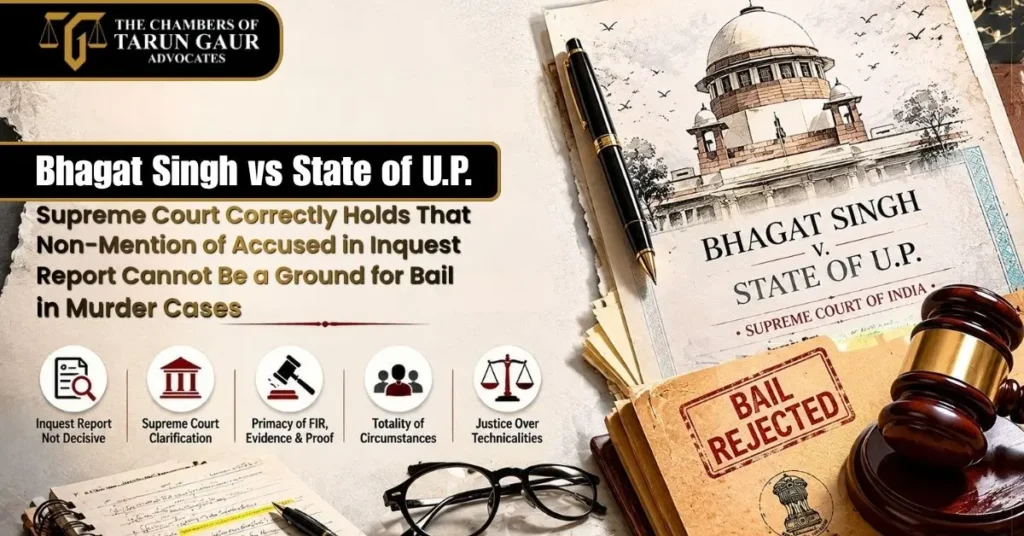
On 22 May 2026, the Supreme Court delivered a significant and much-needed judgment in Bhagat Singh v. State of Uttar Pradesh (Criminal Appeal arising out of SLP (Crl.) No. 4240 of 2026). The Court set aside the bail granted by the Allahabad High Court to the main accused in a brutal daylight murder case, holding that the mere non-mention of the accused’s name in the inquest proceedings cannot, by itself, be a ground to enlarge a person accused of murder on bail.
This judgment deserves full support from the Bar and the Bench alike. It addresses a recurring and deeply problematic practice that every criminal lawyer practising in the mofussil courts, particularly in Uttar Pradesh, Bihar, and Madhya Pradesh, encounters regularly.
The Facts in Brief
The appellant, Bhagat Singh, is the nephew of the deceased Bharat Singh alias Pappu. On 8 March 2025, while the deceased and the appellant were going towards their agricultural field in a village in Mathura district, the respondent No. 2 (Kunwarpal Singh – Accused No. 1) along with two others allegedly emerged from hiding, surrounded the deceased, abused him, and fired multiple shots from country-made pistols, resulting in his instantaneous death.
The FIR was registered the same day after inquest and post-mortem. The accused was named with a specific overt act of firing. During investigation, a .315 bore country-made pistol along with a spent cartridge was recovered at his instance. Chargesheet was filed. The Sessions Court rejected bail. However, the Allahabad High Court granted bail primarily on the ground that the informant (appellant) and another Panch witness had not named the accused during the inquest proceedings.
The High Court’s Flawed Reasoning
The High Court’s order was rightly criticised by the Supreme Court as cryptic and non-speaking. It placed undue and almost exclusive emphasis on the absence of the accused’s name in the inquest report and concluded that it was a fit case for bail “prima facie”.
This approach is not only legally unsustainable but also ignores the ground realities of criminal investigation in rural India.
The Correct Legal Position Reiterated by the Supreme Court
The Supreme Court has once again clarified the limited purpose of inquest proceedings under Section 194 of the Bharatiya Nagarik Suraksha Sanhita, 2023 (corresponding to old Section 174 CrPC). Relying on its earlier decisions in Pedda Narayana v. State of A.P. (1975) and Amar Singh v. Balwinder Singh (2003), the Court held:
The object of inquest is merely to ascertain the apparent cause of death — whether it is suicidal, homicidal, accidental, or caused by machinery, etc. It is not meant to record the detailed manner of the incident or the names of the persons who caused the death.
Non-mention of the name of the accused in the inquest report, therefore, cannot be used to draw an adverse inference against the prosecution, especially when the accused is specifically named in the FIR with a direct overt act, the post-mortem supports the prosecution version (firearm injuries with blackening and tattooing), the weapon is recovered at his instance, and statements of witnesses recorded under Section 180 BNSS also implicate him.
The Ground Reality That Every Practitioner Knows
What makes this judgment particularly important is that it acknowledges — albeit implicitly — a harsh but well-known truth in the criminal justice system:
In village India, influential accused persons frequently work hand-in-glove with the local police. It is not uncommon for the police to deliberately omit or downplay the name of a powerful accused during the inquest proceedings, even when the name has already surfaced. The inquest is conducted in a hurry, often under pressure, and the Panch witnesses (who are usually local residents) are either scared, influenced, or simply not fully informed at that stage.
The FIR, which is registered later after proper investigation, is the document that truly reflects the prosecution case. To give primacy to the inquest report over the FIR, post-mortem, recovery, and witness statements is to turn the law on its head.
The Supreme Court has rightly refused to let such technicalities become a shortcut for granting bail in heinous offences like murder.
Why This Judgment Matters
- It prevents misuse of technicalities: Many High Courts have been granting bail in serious cases solely on the basis of minor omissions in the inquest report. This judgment puts an end to that practice.
- It reaffirms the “totality of circumstances” test: Bail in murder cases must be decided by looking at the entire material — FIR, post-mortem, recovery, witness statements, gravity of offence, and conduct of the accused — and not by isolating one document (inquest report) which has a very limited purpose.
- It protects witnesses in rural areas: In village settings, witnesses often hesitate to name powerful persons at the earliest stage (inquest). Naming them later in the FIR or in statements under Section 180 BNSS does not make their testimony unreliable. The Supreme Court has protected this practical reality.
- It sends a message to lower courts: Cryptic, one-line orders granting bail in serious offences without proper application of mind will not be tolerated.
Conclusion
The judgment in Bhagat Singh v. State of U.P. is a welcome correction. It reinforces that while the right to life and liberty is sacrosanct, it cannot be used as a shield by those who are prima facie involved in brutal murders, especially when the material collected during investigation points towards their guilt.
Non-mention of the accused’s name in the inquest proceedings, simpliciter, is not — and should never be — a ground to grant bail in a case of murder when the FIR, post-mortem, recovery, and other evidence are against the accused.
This is not just good law. It is also good sense — grounded in the practical realities of how criminal cases are investigated in the villages of Uttar Pradesh and elsewhere.
The Supreme Court has done well to restore balance. It is now for the High Courts and Sessions Courts to follow this principle in letter and spirit.